



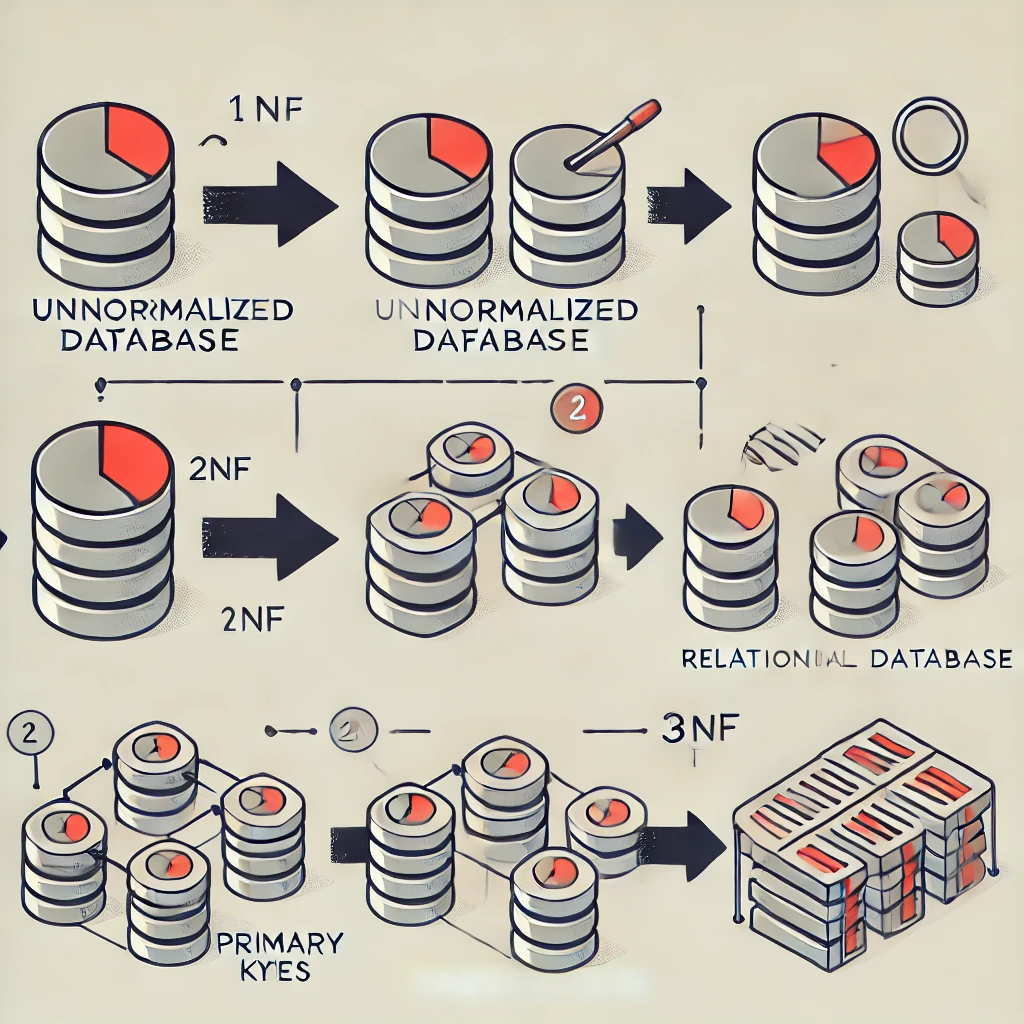
What is Database Normalization?
Database normalization is a systematic approach employed in relational database design to organize data effectively. Its primary aim is to ensure data integrity and efficiency by minimizing redundancy within a database. By normalizing a database, designers optimize how data is stored, thereby reducing the potential for inconsistencies and enhancing data manipulation processes.
The process typically involves breaking down larger tables into smaller, more manageable ones and establishing relationships between them, which serves to organize data logically. One of the key objectives of normalization is to eliminate undesirable characteristics such as insertion, update, and deletion anomalies. For instance, while handling a customer database, if customer information is stored in multiple tables without normalization, modifying a customer’s phone number across all instances would be inefficient and prone to error. A normalized database ensures that updates occur in a single location, thus maintaining accurate information throughout the system.
Another goal of normalization is to create a structure where data dependencies are properly enforced. For example, consider a school database containing students and their enrolled classes. If a student’s details are scattered across several records, it may lead to discrepancies each time an update is made. Normalization helps to keep student information centralized, linked only to their specific classes through foreign keys, ensuring optimal organization.
Normalization is commonly implemented through various forms, starting from First Normal Form (1NF) to Boyce-Codd Normal Form (BCNF), each addressing different aspects of database design. As such, understanding database normalization not only aids database administrators but also influences the overall performance and usability of data systems, resulting in a more efficient and reliable data management strategy.
The Different Normal Forms Explained
Database normalization is a critical process in the design of a relational database, aimed at reducing data redundancy and improving data integrity. The various normal forms serve as guidelines to achieve an efficient database structure. The initial stage, First Normal Form (1NF), requires that all columns in a table contain atomic values, which means that each cell must hold indivisible values. For instance, instead of having a field for phone numbers that lists multiple numbers within a single cell, it should be split into individual columns or rows to comply with 1NF.
Advancing to the Second Normal Form (2NF), a table must first meet the criteria for 1NF, and additionally, all non-key attributes must depend on the entire primary key. This is particularly relevant for tables with composite keys. For example, consider a table holding student grades tied to course IDs. If the student’s name appears and is dependent only on the student ID, then it violates 2NF. To rectify this, the data should be expanded into separate tables, one for student details and another for the course-related data that depend on both key components.
More
The Third Normal Form (3NF) builds on 2NF by insisting that all the attributes are not only dependent on the primary key but also are non-transitively dependent. In simpler terms, this means that there should be no transitive dependencies among non-key attributes. For example, if an employee table contains both employee ID and the department name, and if the department name relies on the department ID rather than the employee ID, a violation occurs. The solution entails creating a separate table for department information.
Finally, we have the Boyce-Codd Normal Form (BCNF), an advanced version of 3NF, which underscores that any determinant must be a candidate key. This can help in further reducing redundancy. The transition from 1NF through to BCNF ensures a more robust database structure, enhancing efficiency and clarity in data management.

Step-by-Step Process to Normalize Your Database
Normalizing a database is a crucial step in ensuring its efficiency and integrity. To begin the process, the first step is to assess your current database structure. This involves reviewing the existing tables, relationships, and data redundancy. A comprehensive analysis allows you to identify the key areas where normalization is needed, such as repetitive data or improper relationships between tables.
Once the assessment is complete, the next phase is determining the normal form applicable to your database. Most databases should aim for at least the Third Normal Form (3NF). Start with the First Normal Form (1NF) by ensuring that all entries in a column are atomic, meaning they contain indivisible values. Subsequently, you move on to the Second Normal Form (2NF), where you eliminate partial dependencies on a composite key. Then, the focus shifts to the Third Normal Form (3NF), which requires that data is dependent only on the primary key, effectively removing transitive dependencies.
During the normalization process, it’s vital to avoid common pitfalls such as over-normalization, which can lead to excessive joins and reduced performance. Carefully consider the trade-offs between normalization and denormalization based on your application’s specific needs. Tools like SQL Server Management Studio or MySQL Workbench can assist you in visualizing and managing your database schema, making the process more efficient.
Furthermore, always document changes made during normalization for future reference. This practice not only provides context for the current structure but also aids future developers or database administrators in understanding the rationale behind the design decisions. Following this structured approach will help ensure a more robust and efficient database.
Benefits of Database Normalization and Real-World Applications
Database normalization offers a multitude of benefits that can significantly improve the overall performance and reliability of data systems. One of the primary advantages is enhanced data integrity. By organizing data into related tables and eliminating redundancy, normalization ensures that only relevant data is stored in each table. This minimizes the risk of anomalies, such as data inconsistencies and duplication, which can lead to erroneous reporting and decision-making.
Another notable benefit of normalization is improved performance. As databases become more complex, normalized databases can streamline queries and optimize data retrieval processes. For instance, when executing queries, a database that is well-normalized requires fewer resources, thereby leading to faster response times and improved efficiency. This performance increase is critical for businesses that rely on quick access to data to operate successfully.
Database normalization also facilitates easier maintenance and scalability. With a well-structured schema, developers can quickly make changes or updates without having to worry about unintended side effects on related data sets. This modular approach not only makes database management simpler but also allows organizations to scale their systems more effectively as their data needs grow.
Real-world applications of database normalization can be observed across various industries. For example, in the finance sector, banks and financial institutions have implemented normalized databases to manage their client information and transaction data. This implementation has led to significant enhancements in data accuracy and operational efficiency. Similarly, e-commerce companies that normalize their product catalogs can offer better service by efficiently managing inventory and customer data, ultimately resulting in improved customer satisfaction.
Conclusion
Overall, the benefits of database normalization are numerous and impactful. Implementing normalization techniques can substantially aid businesses in achieving data integrity, performance optimization, and easier system maintenance, making it a crucial practice for modern database administration.
Read Our Latest Blog
How to Solve Competitive Programming Problems Efficiently
Phone Number: +91-7488456170
Email ID: abhishek@eepl.me
Our Platforms:
Digilearn Cloud
EEPL Test
Live Emancipation
Follow Us on Social Media:
Instagram – EEPL Classroom
Facebook – EEPL Classroom
Stay connected and keep learning with EEPL Classroom !