


As a BCA (Bachelor of Computer Applications) graduate, your resume is your first chance to impress potential employers. A strong resume showcases your skills, experience, and achievements. In this blog, we will guide you on how to create an impressive resume that stands out.
1. Start with a Strong Header
Your resume should start with your name and contact details at the top. This is the first thing employers will see.
Include:
- Full name
- Phone number
- Email address
- LinkedIn profile (optional but recommended)
- Portfolio/Personal website (if you have one)
Make sure your contact details are professional, especially your email address.
2. Write a Clear Career Objective
A career objective is a short paragraph that tells employers your goals. It should be clear, concise, and focused on what you can bring to the company.
Example:
“A highly motivated BCA graduate with skills in web development and database management. Seeking to contribute to a dynamic company while continuing to learn and grow in the field of software development.”
3. Highlight Your Educational Qualifications
As a fresh BCA graduate, your education is important. List your degree and any other relevant certifications.
Include:
- Name of your degree (Bachelor of Computer Applications)
- Name of your university or college
- Graduation year or expected graduation year
- Any relevant coursework or projects
Example:
Bachelor of Computer Applications
XYZ University – Graduated: 2024
Relevant Coursework: Web Development, Database Management, Java Programming
4. Showcase Your Technical Skills
As a BCA graduate, your technical skills are crucial. Employers want to know what programming languages, tools, and technologies you are familiar with.
List your skills under categories like:
- Programming Languages: Java, C++, Python
- Web Technologies: HTML, CSS, JavaScript
- Databases: MySQL, Oracle
- Tools: Git, Visual Studio Code
- Operating Systems: Windows, Linux
Make sure to list the skills you are most comfortable with first.
5. Add Relevant Projects
As a BCA graduate, you likely worked on several projects during your course. Highlight these projects to show what you have worked on.
Include:
- Project title
- Brief description
- Technologies used
- Your role in the project
Example:
Project Title: E-commerce Website Development
Description: Developed a fully functional e-commerce website using HTML, CSS, and JavaScript. Integrated payment gateway and shopping cart.
Technologies Used: HTML, CSS, JavaScript, MySQL

6. Include Internships or Work Experience
If you have completed any internships or have part-time work experience, include it in your resume. It shows employers that you have practical experience.
Include:
- Name of the company
- Job title
- Duration of the internship/work
- Key responsibilities and achievements
Example:
Intern, Software Developer
ABC Technologies – June 2023 to August 2023
- Assisted in developing a mobile app for internal use.
- Worked on fixing bugs and improving app performance.
7. Highlight Soft Skills
While technical skills are important, employers also look for soft skills. These include communication, teamwork, problem-solving, and leadership.
Examples of soft skills to highlight:
- Effective communication
- Time management
- Adaptability
- Teamwork
- Problem-solving
These skills can be included in a separate section or added under your work experience.
8. Add Certifications and Online Courses
Certifications and online courses show your commitment to learning. Include any extra certifications you have earned.
Examples:
- Certificate in Web Development – Coursera
- Java Programming – Udemy
- SQL Database Management – LinkedIn Learning
These certifications prove that you are continuously improving your skills.
9. Use Action Words and Quantify Achievements
Instead of just listing your responsibilities, use action verbs to describe your achievements. Where possible, quantify your achievements to show your impact.
Examples of action verbs:
- Developed
- Designed
- Implemented
- Managed
- Optimized
Example:
“Developed a web application that improved customer engagement by 30%.”
10. Keep the Format Simple and Clean
Your resume should be easy to read. Avoid using too many fonts or colors. Use bullet points to list your skills and achievements. Keep the layout clean and organized.
Tips:
- Use one font (e.g., Arial or Calibri)
- Keep font size between 10-12 pt
- Use headings and subheadings to organize sections
11. Proofread and Edit
Finally, proofreading is key! Make sure there are no spelling or grammatical errors. A well-written resume shows professionalism.
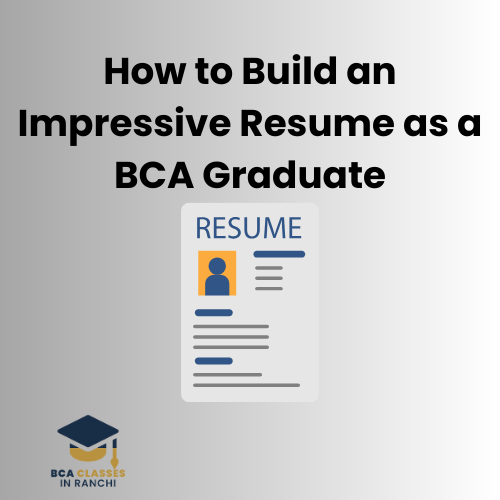
Example Resume Structure
- Header: Name, contact info
- Career Objective: Short, clear goal
- Education: BCA details, relevant courses
- Technical Skills: Programming languages, tools
- Projects: Key projects and technologies used
- Internship/Work Experience: Relevant jobs or internships
- Soft Skills: Communication, problem-solving, etc.
- Certifications: Extra courses or certifications
- Proofread: Check for mistakes
Conclusion
Building a strong resume is an essential step in starting your career as a BCA graduate. Focus on your strengths, showcase your skills, and present your experiences in a clear and organized way. With these tips, you’ll be able to create an impressive resume that will help you land your first job or internship in the IT industry!
Read Our Latest Blog
Emerging Trends in Artificial Intelligence and Machine Learning
Phone Number: +91-7488456170
Email ID: abhishek@eepl.me
Our Platforms:
Digilearn Cloud
EEPL Test
Live Emancipation
Follow Us on Social Media:
Instagram – EEPL Classroom
Facebook – EEPL Classroom
Stay connected and keep learning with EEPL Classroom