


Introduction
When developing modern web and mobile applications, you’ll often encounter APIs. Two popular types of APIs are GraphQL and REST. Both are used to fetch data from servers, but they have different approaches. In this blog, we will compare GraphQL and REST APIs, highlighting their key features, advantages, and differences.
1. What is REST API?
REST stands for Representational State Transfer. It’s an architectural style used for designing networked applications. REST APIs use HTTP requests to perform CRUD operations (Create, Read, Update, Delete) on resources.
Key Characteristics of REST:
- Fixed Endpoints: REST APIs have fixed endpoints for each resource (e.g.,
/users,/posts). - Data Fetching: You can only fetch the data predefined by the endpoint.
- Stateless: Each API request is independent. The server doesn’t store any information about the client’s state.
2. What is GraphQL?
GraphQL is a query language for APIs and a runtime for executing those queries. It allows clients to request only the data they need, making it more flexible than REST.
Key Characteristics of GraphQL:
- Flexible Queries: Clients can specify exactly which fields they want.
- Single Endpoint: GraphQL uses a single endpoint for all queries and mutations.
- Strongly Typed: GraphQL schemas define types, making it easier to validate and manage queries.
3. Key Differences Between GraphQL and REST
3.1 Request Structure
- REST: Each endpoint is designed to handle a specific request. For example,
/usersmight return all users, while/users/{id}returns data for a specific user. - GraphQL: One endpoint can handle multiple types of requests. Clients can query for multiple resources in a single request.
3.2 Data Fetching
- REST: If you need data from multiple endpoints, you may have to make multiple requests. For instance, to get a user’s details and their posts, you might need two requests—one for
/usersand another for/posts. - GraphQL: You can get all the related data in a single request. For example, you can fetch both user details and posts in one query.
3.3 Over-fetching and Under-fetching Data
- REST: You often get more data than you need (over-fetching) or not enough data (under-fetching) because the server determines the data.
- GraphQL: You only fetch the data you specify, eliminating both over-fetching and under-fetching.
4. Performance and Efficiency
4.1 REST
- REST APIs can be slower if multiple requests are needed to fetch related data.
- Because of fixed endpoints, clients might receive unnecessary data in large responses.
4.2 GraphQL
- Fewer Requests: Since clients can request multiple resources in one query, it reduces the number of requests.
- Less Data: By fetching only the required fields, GraphQL reduces the payload size, improving performance.
5. Error Handling
5.1 REST
- REST APIs return HTTP status codes to indicate success or failure (e.g., 200 for success, 404 for not found).
- Error handling is generally simpler, as errors are tied to HTTP response codes.
5.2 GraphQL
- GraphQL doesn’t rely on HTTP status codes. It returns errors in the response body.
- Clients need to parse the response to check for errors in data or the query itself.
6. Versioning
6.1 REST
- Versioning: REST APIs often require versioning, especially if the API changes over time (e.g.,
/v1/users,/v2/users). - Breaking Changes: Changes to the API may break existing functionality, forcing developers to update their code.
6.2 GraphQL
- No Versioning: GraphQL doesn’t require versioning. If the schema evolves, older clients can still use the API as long as they request only the fields they need.
- Backward Compatibility: New fields can be added without breaking existing queries.
7. Complexity and Learning Curve
7.1 REST
- Simple to Implement: REST is relatively easier to implement, especially for small applications.
- Standardized: Since REST is well-known, most developers are familiar with it, making it easier to get started.
7.2 GraphQL
- More Complex: GraphQL can be more complex to set up, especially for developers who are not familiar with its schema-based approach.
- Learning Curve: Developers need to learn how to structure queries, mutations, and handle schemas effectively.
8. Use Cases for GraphQL and REST
8.1 When to Use REST
- When you have a straightforward application with clear endpoints.
- If your app doesn’t require fetching related data in a single query.
- When you want a simpler, well-understood solution.
8.2 When to Use GraphQL
- When your app needs to retrieve data from multiple sources in one request.
- If you want to avoid over-fetching and under-fetching data.
- When you want more flexibility for the client-side developers.
9. Conclusion
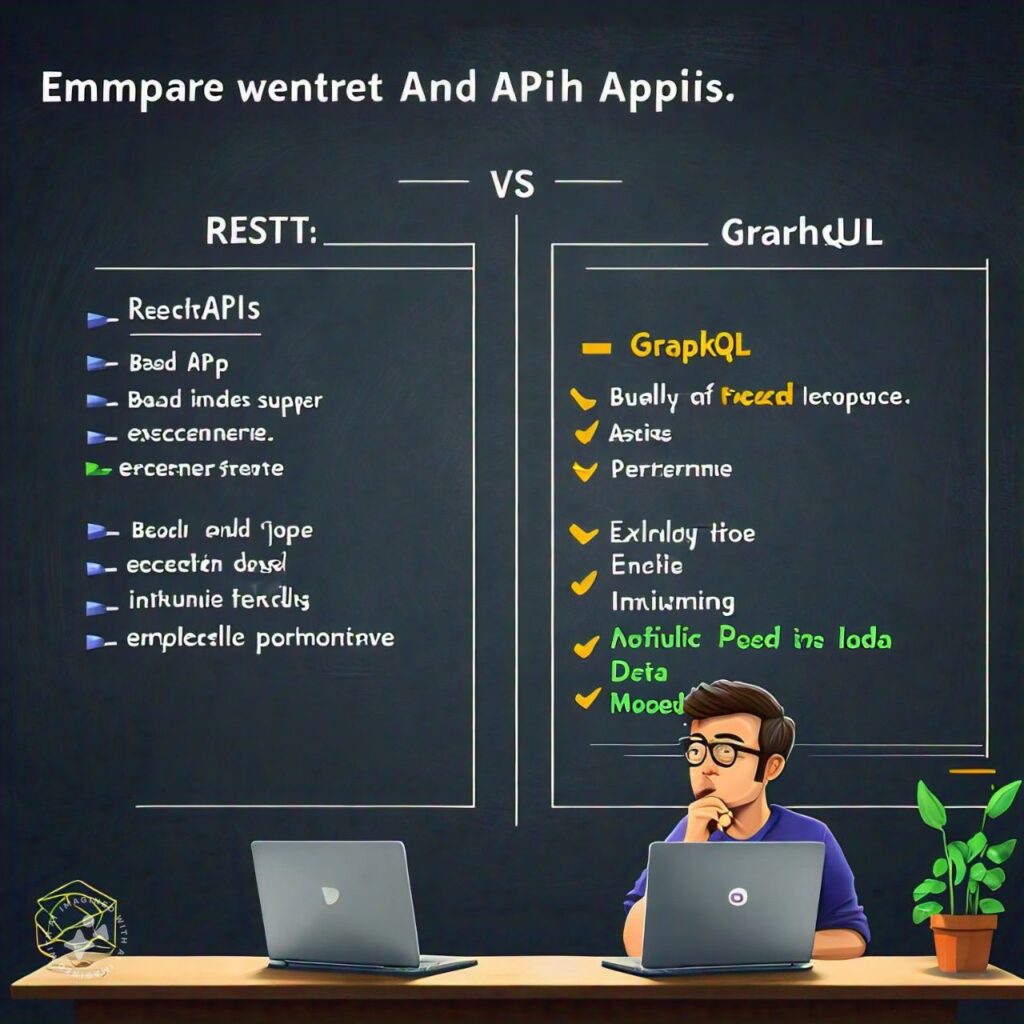
Both GraphQL and REST have their strengths, depending on your project needs. REST is simple and widely used, while GraphQL offers more flexibility and efficiency for complex applications. If you want to avoid over-fetching, under-fetching, and multiple requests, GraphQL is the better choice. However, for simpler, more standardized projects, REST might still be the best option. Choose wisely based on your project’s requirements and team expertise.
Read Our Latest Blog
Django vs Flask: Choosing the Best Framework for Scalable Applications
For More Information and Updates, Connect With Us
Name Abhishek
Phone Number: +91-7488456170
Email ID: abhishek@eepl.me
Our Platforms:
Digilearn Cloud
EEPL Test
Live Emancipation
Follow Us on Social Media:
Instagram – EEPL Classroom
Facebook – EEPL Classroom
Stay connected and keep learning with EEPL Classroom!