



Introduction
Object-Oriented Programming (OOP) is one of the most important concepts in computer programming. It focuses on organizing code using objects, which makes it easier to understand, use, and reuse. If you’re a beginner, don’t worry. I will explain OOP in simple terms with real-life examples to help you grasp the concept.
What is Object-Oriented Programming?
At its core, OOP is a way to structure your code around “objects.” These objects are like real-world entities. For example, think of a car, a dog, or a book. Each object has two main components:
- Properties: These describe the object (e.g., a car’s color or a dog’s breed).
- Actions (Methods): These define what the object can do (e.g., a car can drive, or a dog can bark).
OOP is based on four main principles:
- Encapsulation
- Abstraction
- Inheritance
- Polymorphism
Let’s break these down with simple examples.
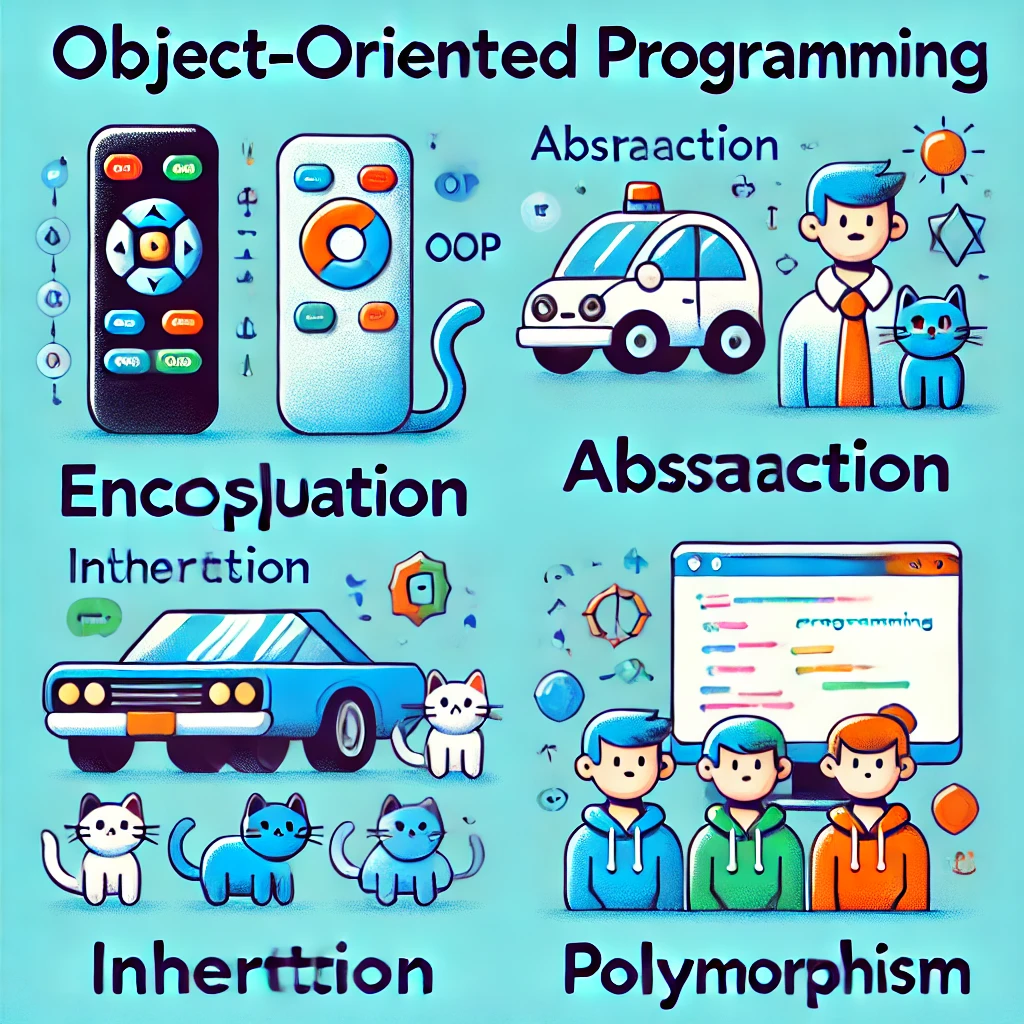
1. Encapsulation: Grouping Data and Functions
Encapsulation is like putting all related information and actions together in one place. Think of a television remote.
- The buttons (functions) are inside the remote.
- You don’t see the complex wiring or circuits; you just press buttons to control the TV.
In OOP, encapsulation helps to protect data. You only expose what is necessary. For example, if you build a banking app, you wouldn’t let everyone see how your code calculates balances. Instead, users interact with buttons like “Check Balance” or “Transfer Money.”
2. Abstraction: Hiding Complexity
Abstraction simplifies complex things by showing only what is necessary. Imagine you’re driving a car.
- You don’t need to know how the engine works.
- All you care about is using the steering wheel, accelerator, and brakes.
In programming, abstraction hides complicated processes. It shows only the essential parts. For example, when you use a mobile app to order food, you just select the items and pay. You don’t see the backend code that processes your order.
3. Inheritance: Reusing Code
Inheritance allows one object to borrow features from another. Let’s say you are designing software for animals.
- You create a general class called Animal.
- This class has properties like “legs” and “sound.”
- Now, you create specific classes like Dog and Cat. These classes automatically inherit features of Animal but can also have their unique traits.
For instance:
- A Dog has four legs and barks.
- A Cat also has four legs but meows.
With inheritance, you don’t have to write the same code for “legs” and “sound” again for every animal.
4. Polymorphism: One Action, Different Outcomes
Polymorphism means one action can behave differently based on the situation. Think about a person.
- At home, they are a parent.
- At work, they are an employee.
- In the park, they may be a jogger.
In programming, polymorphism works similarly. Example, if you create a method called draw(), it can behave differently for different objects:
- For a circle, it draws a round shape.
- For a square, it draws a four-sided figure.
How Do We Use OOP in Real Life?
Here are a few real-life scenarios where OOP concepts shine:
1. Online Shopping Systems
- Objects: Users, Products, Carts.
- Encapsulation: Users can add products to their cart without knowing how the system stores that data.
- Inheritance: Different types of users (buyers, sellers, admins) can share common features like login and profile management.
- Polymorphism: Payment methods like credit card, PayPal, and wallet work differently but share the same interface.
2. Game Development
- Objects: Characters, Weapons, Vehicles.
- Encapsulation: Each character’s stats (health, speed) and actions (attack, jump) are stored and managed separately.
- Inheritance: A base class Character can have subclasses like Hero and Enemy, which inherit common traits.
- Polymorphism: Characters can interact with weapons differently, like using a sword or a gun.
3. Banking Software
- Objects: Accounts, Transactions, Customers.
- Encapsulation: Customers can see their account balance but not the code behind it.
- Inheritance: Different account types (savings, checking) inherit common behaviors from the Account class.
- Polymorphism: Different types of transactions (deposit, withdrawal) share the same method but execute differently.
Benefits of OOP
- Reusability: You can use the same code for similar objects, saving time and effort.
- Scalability: It’s easy to add new features or objects.
- Maintenance: Managing and fixing code becomes simpler.
Conclusion
Object-Oriented Programming makes coding easier and more logical. It lets us organize our code the same way we organize real-world objects. By understanding concepts like encapsulation, abstraction, inheritance, and polymorphism, you can write better and more efficient programs.
Start small. Practice by creating simple programs with classes and objects. Over time, these concepts will become second nature. Happy coding!
Read Our Latest Blog
GraphQL vs REST: The Best API for Speed, Flexibility & Performance
For More Information and Updates, Connect With Us
Name Abhishek
Phone Number: +91-7488456170
Email ID: abhishek@eepl.me
Our Platforms:
Digilearn Cloud
EEPL Test
Live Emancipation
Follow Us on Social Media:
Instagram – EEPL Classroom
Facebook – EEPL Classroom
Stay connected and keep learning with EEPL Classroom!